 Spotify
 Apple Podcasts
 Podcast Addict
 Overcast
 Podcast RSS
SpaceX Identifies Unshared Ephemeris Data as Primary Orbital Collision Hazard in Low Earth Orbit
Original Publication Date: 2026-10-08 23:29

On October 6, 2026, SpaceX warned that the biggest obstacle to safe satellite operations is the reluctance of operators to share ephemeris data, including exact positions and maneuver plans. The company said that without this information, collision avoidance becomes far more difficult, raising the risk of debris. SpaceX urged the industry to adopt common data‑sharing protocols and called on regulators to enforce transparency. The firm’s call comes amid growing concerns over the increasing crowdedness of Earth’s orbits.
GAO Report Finds Full Deployment of Secure Military GPS Receivers Delayed to 2049 and Beyond
Original Publication Date: 2026-10-08 21:06

The U.S. Government Accountability Office released a report on October 7, 2026, warning that the deployment of modernized military satellite navigation equipment will take far longer than originally planned. The GAO’s findings show extended timelines across all armed‑forces operational platforms, raising concerns about readiness and cost overruns. Experts say the delays stem from integration challenges and supply‑chain bottlenecks that have slowed the rollout of critical navigation upgrades. These setbacks could affect the U.S. Military’s ability to maintain precise navigation in future operations.
DOT Proposes Five FAA Rule Changes to Streamline Part 450 Commercial Launch Licensing
Original Publication Date: 2026-10-08 20:58

On October 6, 2026, Secretary of Transportation Sean Duffy announced five proposed rule changes to revise the FAA’s Part 450 framework for commercial launch and reentry licensing. The proposals aim to streamline the approval process, enhance safety oversight, and better align regulations with the rapidly expanding space‑flight industry. Duffy emphasized that the changes will reduce administrative burdens while maintaining rigorous safety standards for commercial launch operators. The FAA is now expected to review the proposals and invite public comment before moving forward.
SpaceX Granted U.S. Patent for Direct-to-Cell Beam Synchronization and Delay Compensation Technology
Original Publication Date: 2026-10-08 17:12

On October 8, 2026, the USPTO granted SpaceX Patent No. 12,757,141 B1, covering a beam synchronization and signal‑delay compensation system that improves the reliability and precision of satellite communications. The invention addresses timing mismatches in high‑frequency beam transmission, enabling smoother coordination between multiple antennas and reducing latency. SpaceX claims the technology will enhance its Starlink network and other orbital payloads. The patent underscores the company’s ongoing push to refine its space‑based infrastructure.
Muon Space Appoints Chief Product Officer and Head of Strategy as Company Scales Constellation Operations
Original Publication Date: 2026-10-08 16:57

On October 8, 2026, satellite platform developer Muon Space announced an expansion of its executive leadership team.
Floodwaters Overwhelm Thailand
Original Publication Date: 2026-10-09 04:01

NASA’s Earth Observatory shows a dramatic increase in floodwater along Thailand’s Bang Pakong River in early October 2026, compared to the same area a year earlier. Heavy rains from a stalled low‑pressure system, amplified by warm Gulf of Thailand moisture, dumped nearly 300 mm of rain in Bangkok over 48 hours and flooded 50 provinces. The floods displaced over 4 million people, caused dozens of deaths, and damaged roughly 270 000 hectares of rice fields and orchards. These images underscore the growing threat of extreme rainfall events to Southeast Asian agriculture and communities.
NASA Briefing to Highlight Contributions to Martian Moons Mission
Original Publication Date: 2026-10-08 20:22
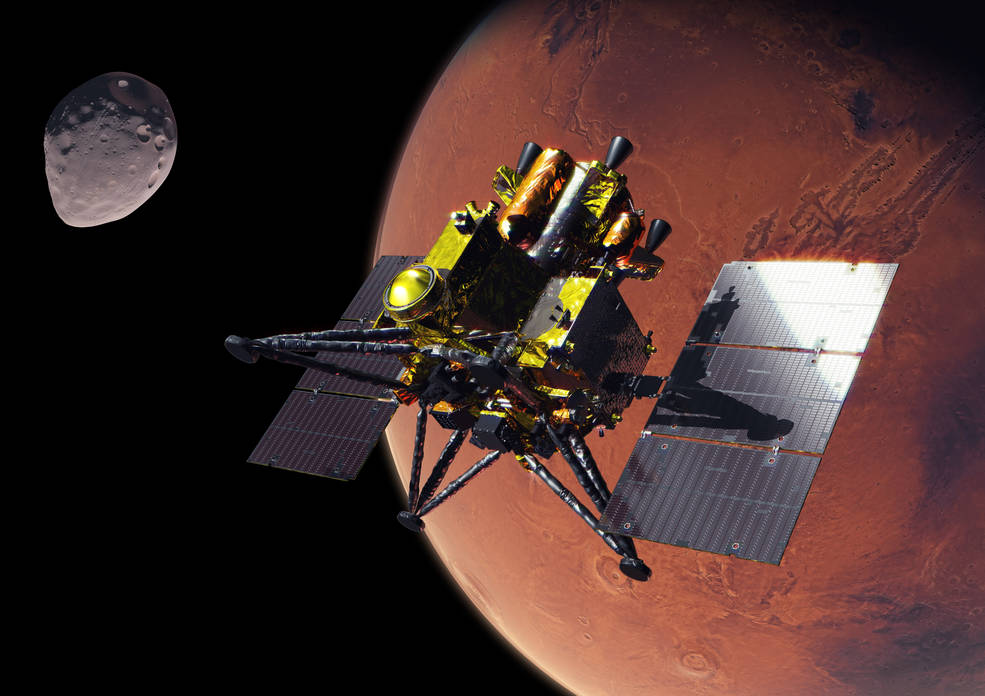
NASA will host a media teleconference on Thursday, Oct. 15 at 4 p.m. EDT to preview its role in JAXA’s Martian Moons eXploration (MMX) mission, which launches from Tanegashima on Oct. 19. The MMX spacecraft will arrive at Mars in August 2027, survey Phobos and Deimos, and collect a moon sample by December 2028 for delivery to Earth in 2031. NASA’s contributions include the MEGANE gamma‑ray spectrometer, the surface sampler mechanism, and Deep Space Network support, all funded through its Discovery Program.
Fortastra Raises $30M Series A to Fund its Next Security Spacecraft
Original Publication Date: 2026-10-08 13:00

Fortastra, a California‑based startup building orbital‑defense spacecraft, has closed a $30 million Series A led by First In and joined by Space Capital, Upfront, Rsquared, Side Door Ventures, ATX Ventures and others, to accelerate its next‑generation platform. The funding comes amid growing U.S. Focus on space weapons, with Air Force Secretary Troy Meink’s recent remarks easing financial pathways for commercial firms like Fortastra. The company plans to launch its first production craft as early as Q1 2028, featuring sensors, propulsion, and autonomous threat‑response capabilities to give troops multiple options against adversarial satellites. With a short‑term goal of one launch per year and a long‑term vision of hundreds or even thousands, Fortastra aims to meet the DoD’s expanding demand for robust, low‑cost space‑security solutions.
DOT Proposes Changes to Part 450 Licensing Rules
Original Publication Date: 2026-10-08 12:19

The U.S. Department of Transportation announced five new FAA rules to streamline the Part 450 commercial space launch licensing process, aiming to balance safety with efficiency as the White House targets 1,000 launches per year by 2030. The proposals, issued by the newly formed SPACE Task Force, will consolidate documentation, allow electronic submissions, and simplify risk analyses, including removing the word “hypothetical” from far‑field blast requirements. These changes come after years of industry complaints and a 2025 executive order urging DOT to reevaluate the rule, and public comments will be accepted until November 4. The FAA says these updates are just the beginning of its effort to cut regulatory red tape for space operators.
RIP Margaret Hamilton, whose code saved the Apollo 11 Moon landing
Original Publication Date: 2026-10-08 20:15

Margaret Hamilton, who coined the term “software engineering” and led the development of NASA’s Apollo flight software, died at 90. Her pioneering work helped land astronauts on the moon and earned her the Presidential Medal of Freedom in 2016. She was also honored as a LEGO minifig in the “Women of NASA” set, joining peers Mae Jemison and Sally Ride. Hamilton’s legacy as a pioneer of software engineering and a key contributor to the Apollo program remains a testament to innovation and collaboration.